The best creature in Gen 1 came with a note from the model that designed it:
Replaced the rear leg's high-gear hip motor with a low-gear, high-range
spring-like joint to store energy in a deep crouch before releasing it
for a massive leap.
It scored 1032. The next best creature in the whole world was at 863. The model called it "Spring-Loaded Jumper," which sounded great and all until I realized that a motor can't store energy and there are no springs in this world.
That got me sus...
Where Things Are
Quick recap if you missed Post 0: a local model designs creatures (a body plus a little Python brain), a physics engine tests them, and the ones that do well get bred into new ones. Gen 1 is the first world, and it runs until it stops finding new things.
It hasn't stopped. As of this morning there are 510 species, 166 new dex entries in the last 24 hours alone, and the number I use to track how full and how good the world is went up 13% in a day. So it's definitely still cooking right now, not done just yet.
The best honest score has gone like this:
claude's starting creatures         223
first morning                       574
the next afternoon                  794
Spring-Loaded Jumper               1032
Most of the creatures still barely move. That hasn't changed and I don't think it will. But the top keeps getting better, and the creatures up there now actually look like they're doing something on purpose.
They Have Names Now
For the first day every creature was just "???", which got old fast. Now the 122B looks at a filmstrip of the creature plus what it measured and builds a name out of roots. The first four were Glacileap, Pentapod, Saltuskel and Saltivex. Evolutions keep their parent's stem, so Pentapod evolved into Pentavol, and Saltuskel into Saltivex. The model explains its own etymology too which is neat.

There's also a family tree now, If you hover over the starwheel Claude wrote on day one, the whole champion roller dynasty lights up. Both of the 574 rollers from the first night are its descendants, through fusions (two parents bred into one).
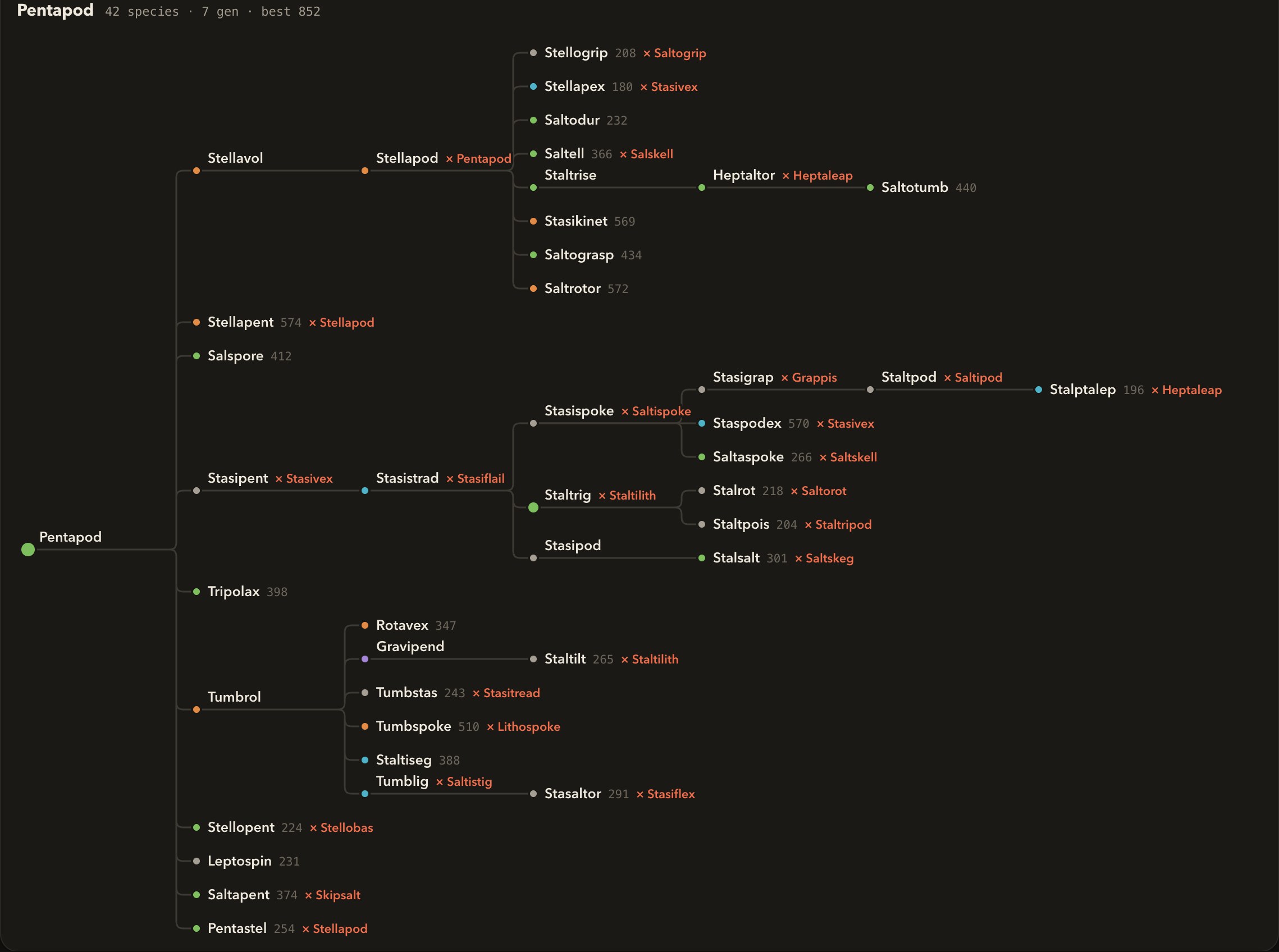
The tree also showed me that the world is way less connected than I assumed. 163 of the 490 species have never had a relative at all. They got invented, got judged, and nothing ever bred from them. The rest group into around 45-50 lineages, and the deepest goes 7 generations.
Big Model vs Small Model, Again
The original bake-off said the 122B was better at making small edits to existing creatures. But that was 4 tasks per model. So I ran it again inside the live world: 50 edits each for the 35B and the 122B, alternating in blocks of 10 so both had the same hours and the same parents to work with.
                         35B      122B
judged clean             74%      88%
mean score of children   280      245
beat their parent        31%      21%
seconds per edit          20       49
The 35B makes more junk, but it's 2.4x faster and its children were at least as good, so per hour of GPU time it produced about 3x as many improvements. It also bred the 794 creature, which was the best in the world for a while.
Four tasks said the big model. Fifty said the small one. The quality difference isn't statistically significant yet (the speed difference absolutely is), but the lesson for me was mostly just that I need bigger sample sizes. The bake-off was right about inventing creatures from scratch though, that one wasn't close. Inventing needs arithmetic against the weight limit, and the big model with thinking on is the only one that does the arithmetic. Definitely something to consider as I go further into this.
Making the Physics Pickier
After the first night the champions were scoring really high really fast, and I didn't trust it. Watching a replay doesn't help either, because the cheats that matter here live inside the physics math, not in anything you can see.
So I added a re-audit. It re-runs a creature with the physics stepping 4x more finely, with 5 different starting poses. An honest gait should keep basically the same score when the physics gets more precise. Something exploiting a quirk of the simulation usually falls apart.
I ran it over every niche champion, every record holder and every suspicious creature:
confirmed honest (already clean)           38
confirmed honest (had been held back)      33
"inflated", kept 50-75% of their score     23
cheats                                      9
Three of the 9 cheats had passed every check I had before. One was a top-five creature. Another was a third-form evolution. I haven't checked yet whether the forms before it were cheating too or if the cheat only showed up at the end, but either way evolution had stacked a whole chain on top of it. Its score dropped from 178 to 79. A creature that was being held back as suspicious at 691 dropped to zero.
The flip side was nice though: 33 creatures I'd been holding back for looking suspicious turned out to be fine and got released into the world.
The 23 "inflated" ones are kind of their own finding. They're not cheating, but the default physics flatters a lot of gaits by 25-40%.
The caught cheats all go to the Glitch Gallery (the hall of shame from last post), which now sorts them into floor sinkers, timestep surfers and integrator surfers. Which are basically just three different ways of tricking the physics.

The Spring-Loaded Jumper
So back to the 1032.

When I watched its replay, its legs looked like they were sinking into the ground and getting shot back out. Which is the exact thing the very first cheater did. So my guess was that it was doing the same trick but sneakily, sinking in between the moments where my check looks.
It passed the re-audit though, keeping 91% of its score. I also checked my guess by making a copy that measures how far it sinks after every single physics step, not just the ones my check looks at. It sank at most 3 mm more than what my check had already seen. So nothing was hiding between checks and my guess was just wrong.
The actual answer is kind of funny. In MuJoCo, contact isn't perfectly hard, the floor behaves like a stiff, damped spring. Push into it and it pushes back. And that's the same no matter how finely you step the physics, which is exactly why the re-audit couldn't see it.
So I re-ran the top 12 creatures on a stiffer floor:
                          soft floor   stiff floor   change
Spring-Loaded Jumper            1031           700     -32%
the next best hopper             858           779      -9%
its own parent                   720           641     -11%
(1031 instead of 1032 because I ran this on my Mac, and the same creature can score slightly differently on different computers.)
On the stiff floor it drops from first to fourth. Its grip goes from 207 to 67.
The thing is though, every top creature sinks a little. All 12 sink 1-7 cm. The rollers sink the most just because they're big and round, which is totally honest. The Jumper isn't breaking any rule. It's just the best at using something the world gives everyone. It's the only one built around it on purpose, and the model even wrote down that it was doing it, it just thought the spring was in the joint.
I didn't punish it since changing the rules halfway through Gen 1 would make Gen 1's numbers meaningless, and a stricter sinking limit would mostly just punish the honest rollers and give evolution a new line to sit right under. So the Jumper keeps its spot, and Gen 2 gets a harder floor.
Limbs Inside Each Other
One more thing I didn't notice for way too long: limbs can pass through each other. That was on purpose at the start, since self-collision is a classic way for creatures to cheat by kicking themselves. But it also means creatures can be designed in ways that are physically impossible.
So I re-judged all 316 clean creatures with self-collision on. About one in seven had limbs overlapping each other just standing still, and nobody (me) had noticed. Most of the champions barely cared, the 794 went to 796. One 658 roller with 8 overlapping limbs dropped to 398 though, and the third-form hopper from the first night went from 524 to 417.
Does the AI Judge Have Taste?
I haven't really got the chance to talk about this yet so i'm fitting it at the end here. There's a second judge on top of the physics that I'm calling the Professor. It's the 122B, shown two creatures and asked which one is more interesting. The idea is that a score only rewards what I thought to measure, and I wanted something that could notice a creature being weird in a good way.
The first time I tested it, the 35B picked "B" four times out of four, whoever B was. So before giving it any say over anything, I measured it. I showed it 32 pairs, each in both orders, with the numbers hidden. The 122B picked the same creature both times about 72% of the time, which is usable.
The catch was 83% of its consistent picks were just the higher-scoring creature. It couldn't see the scores and it still mostly picked whichever one moved better. So by default its "interesting" mostly just means "good at moving", which the physics already tells me.
So the only part that matters is the other ~15%, where it goes against the score. I built a little voting page where I watch two creatures without knowing which is which and pick the one I like.
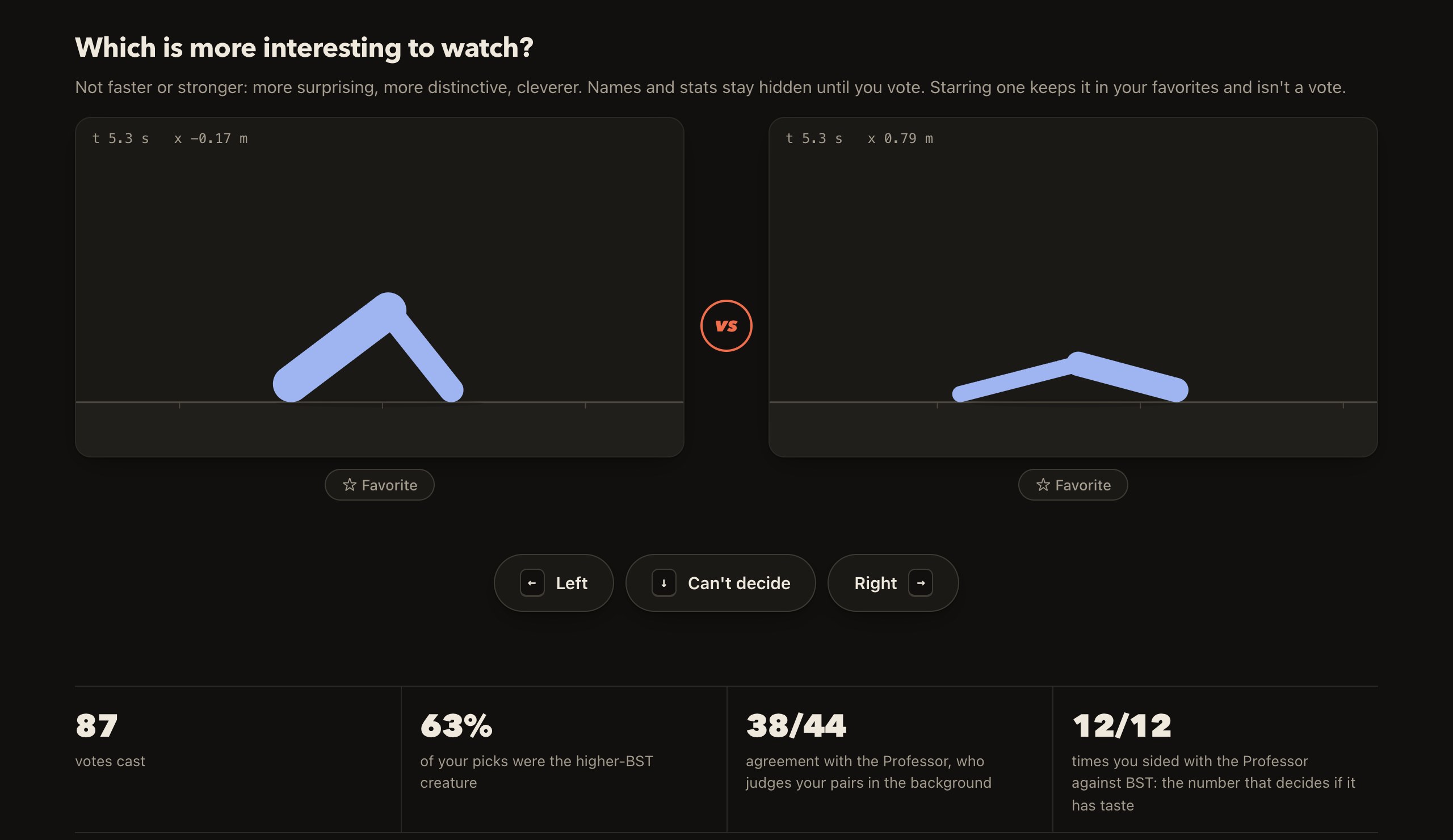
After 87 votes, there were 12 pairs where the Professor went against the score. I sided with the Professor on all 12.
But again I learned small sample sizes are speculative at best so I'll wait and see about the Professor.
What's Next
Gen 1 keeps running until it stalls. When it does, Gen 2 starts with:
- a harder floor (sorry Jumper)
- self-collision on
- rough ground, and a seventh stat for handling it
- stats without the 255 cap, since a bunch of them are already maxed
- the 35B doing edits and the 122B doing inventing (possibly introducing Qwen 3.8 depending on my research on it)
- Gen 1's best creatures as the starting population
The question I'm most curious about is whether the Jumper's family survives the harder floor or whether something completely different takes over.
'Til next time!